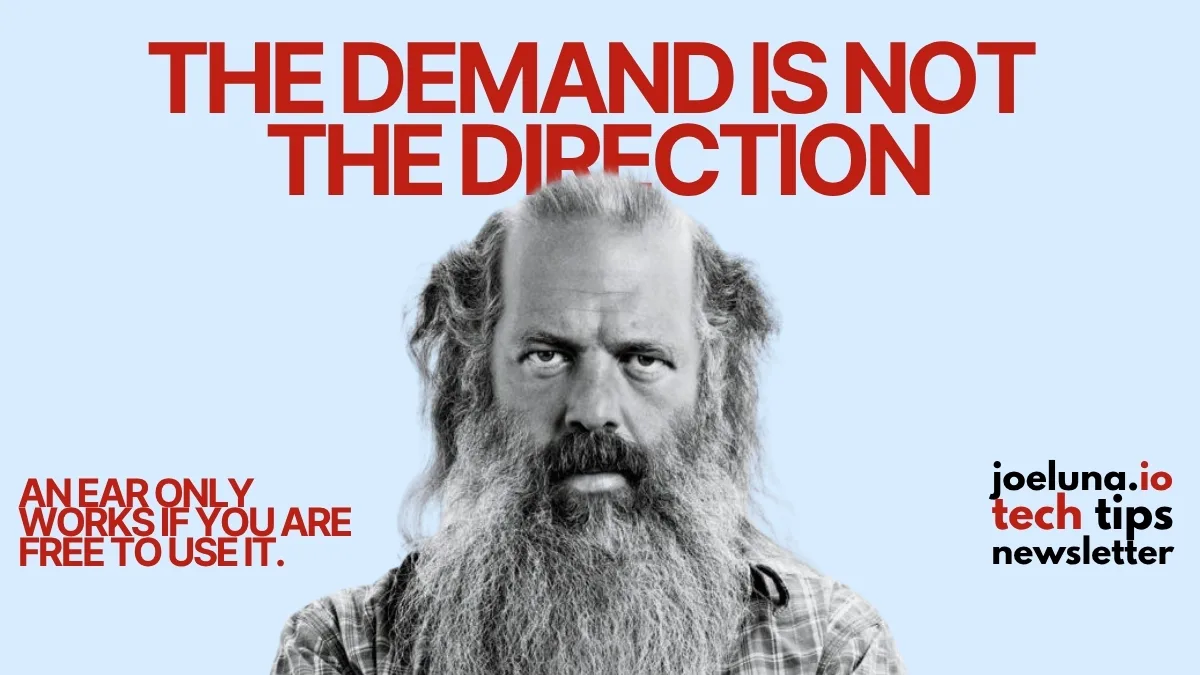
Last edition was about the ear: when AI can produce everything, the value is in knowing which part is worth building on. This one is about the harder half. An ear only works if you are free to use it.
Rick Rubin told a story on The Diary of a CEO about Linkin Park. They had made three albums in the same rap-rock style, and they were one of the biggest bands in the world doing it. The easy move was a fourth. The audience would have loved it.
They went looking for their next sound instead. By Rubin's account, about half the audience didn't like it, half loved it, and new people showed up. The band set itself up for a much longer career than the wave it came from.
Every owner gets that choice. Clients want the last hit. The industry has a standard package. Competitors set the menu. Most of the week gets spent answering what is demanded, and very little of it on the thing only you would build.
I lived a version of this. For five years as an IT director, I was known for one thing: showing up, fixing whatever broke, and leaving. That was the hit everyone wanted from me.
From that seat I could also see where the company was falling behind. They were firm about not using AI, and I could picture exactly the kind of assistant that would have helped them. I never got the OK to build it. So for five years I fixed other people's problems instead of building the thing that would have helped them long term.
When I left, the idea left with me. It became FIVE75 and the Company OS: one system that holds how a business actually runs, with AI working on top of it. I turned disorganization into a product. The first client to run on it told me that after almost ten years in business, she finally felt organized.
The demand is not the direction.
Rubin once brought a song called "Sugar" by a young band named System of a Down, to the program director of the biggest alternative station in Los Angeles. The answer was not just no. They would never play this band. A year later it was the station's most requested song.
He is careful not to call that a formula. What he will say is that they made the things they loved and never asked where it fit in the market.
"It's only through the risk that the greatness is shown."
In a regulated business, that is not permission to gamble with client data or your license. The risk worth taking is in the offer: the service nobody in your field packages yet, the way you could work if you stopped copying the firm down the street.
List what you do only because it is expected. The report nobody reads. The package everyone in your field sells. Circle one to rethink.
Quitting makes room.
We celebrate starting and treat quitting as failure. Rubin argues the opposite order. You cannot start anything big without ending something first, because ending it creates the space the next thing needs.
His example was Jay-Z, who walked away from the champagne brand he had helped make famous after its leadership was dismissive about his audience. It cost him in the near term. The gap it left became room for a brand of his own.
Rubin is not anti-commitment. He says commitments are good to make and good to keep. The skill is noticing when one has quietly turned into a box: the client who drains the team, the service line that pays but eats every week.
Name one thing to end this quarter, and find the cleanest way to end it.
Make the next one.
Put those two together. The thing you circled, and the room you cleared by ending something. That is where the next one gets built.
Linkin Park had to stop making the old record before they could find the new one. Some of the audience left. New people came, and the band got a much longer career out of it. Expect the same. Some clients will prefer the old package, and that is fine. The right ones find the new thing because it sounds like you and nobody else.
So this month, take the hours you freed up and build a small first version of the work only you would make. Show it to three clients you trust. Their reaction will tell you more than any market survey.
Part 1, Taste Is the Job Now, was about hearing what is good. This one is about making room to build it. Everyone will keep asking for your last hit. It paid for this year. The next one is the one only you can make.
This week in AI: Kill It or Skill It
This week I wanted to share a Claude skill called /brag. It turned a project into a 10-second video. That was all it did.
Once it worked reliably, a better question showed up. What happens if other steps can call it?
A transcript supplies the source. AI picks the strongest ideas. Another step writes the angle and the script. /brag makes the video. The same source becomes an article too.
It stopped being a video generator. It became a production line. The lesson: judge a skill by what it makes possible when something else can call it, not by what it does alone.
"Create a video." "Analyze a transcript." "Write in this voice." "Review this against our standards." Each one looks like a small convenience. Chained together, they are a business process that no longer needs a person at every step.
So I have stopped asking what giant agent to build. I ask what this business should know how to do, then turn each answer into a skill. Small, reliable, reusable.
Sometimes the gap between a clever AI trick and a workflow is one small skill that finally works.